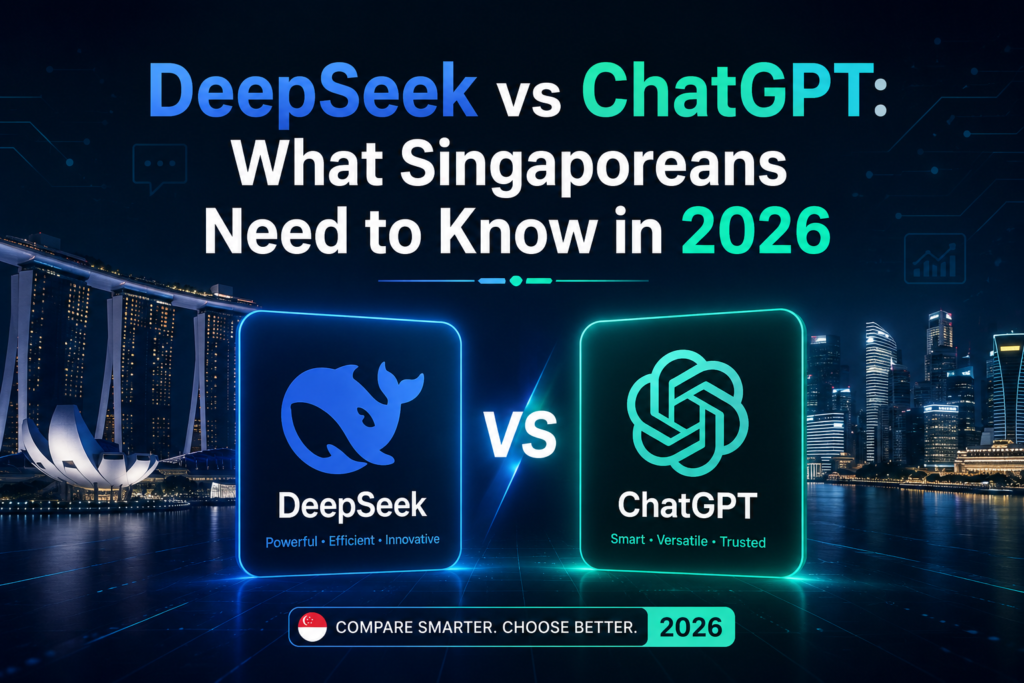
In January 2025, a Chinese AI company called DeepSeek released an AI model that sent shockwaves through the technology industry. It outperformed ChatGPT on several key benchmarks while reportedly costing a fraction of the amount to train. Nvidia’s stock dropped by nearly 17% in a single day as investors questioned whether the enormous infrastructure investment underpinning US AI companies was necessary. DeepSeek became one of the most downloaded apps in the world within days of its release.
For Singaporeans, the question was immediate and practical: should I switch from ChatGPT to DeepSeek? Is it better? Is it safe? This guide gives you the complete, honest answer covering what DeepSeek actually is, what it does well, what the real risks are for Singapore users, and how to think about whether it belongs in your AI toolkit.
What is DeepSeek and Why Did it Shock the World?
DeepSeek is an AI research company based in Hangzhou, China, founded in 2023 as a subsidiary of High-Flyer, a Chinese quantitative hedge fund. In January 2025, DeepSeek released DeepSeek-R1, a reasoning model that matched or exceeded the performance of OpenAI’s o1 model on several mathematical and coding benchmarks.
What made this remarkable was the reported cost. OpenAI and other US AI companies had spent hundreds of millions of dollars training their frontier models. DeepSeek claimed to have trained its model for approximately $5.6 million USD. Whether this figure is fully accurate has been debated, but the underlying point remains: DeepSeek demonstrated that world-class AI capability could be achieved with significantly fewer resources than previously assumed.
DeepSeek’s models are open source, meaning anyone can download and run them on their own servers. This is different from ChatGPT, Claude, and Gemini which are closed systems that you can only access through their official interfaces. The open source nature means developers and organisations can host DeepSeek privately, modify it for their specific needs, and integrate it into their own products without paying per-query API fees.
What DeepSeek Actually Does Well
Mathematical reasoning and logic: DeepSeek-R1 was specifically designed as a reasoning model. It approaches complex problems by breaking them down step by step and showing its reasoning process. For tasks involving mathematics, logical deduction, and structured problem-solving, DeepSeek performs at a genuinely impressive level that matches or exceeds what most users will encounter from ChatGPT’s standard models.
Coding: DeepSeek performs strongly on programming tasks. Developers who have tested it extensively report that it produces clean, functional code and is good at debugging. For Singapore developers and technical teams looking for a cost-effective coding assistant, DeepSeek is worth serious consideration for non-sensitive development work.
Cost for developers: If you are a developer or running a business that integrates AI through APIs, DeepSeek’s API pricing is dramatically lower than OpenAI’s. This makes it genuinely attractive for building AI-powered applications where cost per query matters.
Accessibility: The basic consumer interface at chat.deepseek.com is free to use. For everyday text-based tasks, the output quality is strong and competitive with ChatGPT’s free tier.
The Privacy and Data Concerns Every Singaporean Must Understand
This is where the conversation becomes more nuanced and where Singaporeans specifically need to pay careful attention.
DeepSeek is a Chinese company and is therefore subject to Chinese laws, including China’s National Intelligence Law which can compel Chinese organisations to cooperate with state intelligence work. DeepSeek’s privacy policy acknowledges that it stores data on servers in China. This has led multiple governments and regulatory bodies around the world to raise concerns.
In Singapore’s context this matters in several ways. Singapore’s Personal Data Protection Act (PDPA) requires that personal data is protected regardless of where it is processed. When you enter personal data about yourself or others into DeepSeek, that data may be stored on servers subject to Chinese law in ways that are not fully consistent with PDPA obligations. For businesses operating in regulated industries in Singapore — financial services, healthcare, legal, and government — this creates real compliance risk.
Several countries and government agencies have taken formal action. Italy blocked DeepSeek in early 2025. The US Department of Defense and multiple US federal agencies restricted its use. Australia’s government departments were advised against using it for sensitive work. South Korea’s government investigated its data practices.
This does not mean DeepSeek is unsafe for all uses. It means Singapore users need to think carefully about what data they put into it. The risk profile is different depending on what you are doing.
The Censorship Issue
DeepSeek has been widely documented to refuse to answer questions about topics that the Chinese government considers sensitive. This includes questions about the 1989 Tiananmen Square events, Taiwan’s political status, Xinjiang, Tibet, and various other politically sensitive topics from China’s perspective.
For most everyday Singapore users doing business tasks, this limitation will never come up. But for journalists, researchers, academics, educators, and anyone using AI for comprehensive research, this is a meaningful constraint. An AI tool that has been trained to avoid certain topics is fundamentally less useful for research that might touch those areas, even indirectly.
There is also a broader philosophical concern that some Singapore users raise: by using a tool that has built-in political censorship, you are in a small way normalising that approach to AI. This is a personal consideration rather than a practical one, but it is worth being aware of.
DeepSeek vs ChatGPT: Practical Performance Comparison
For everyday writing tasks like emails, social media content, blog posts, and business documents: ChatGPT and DeepSeek produce comparable quality output. Neither has a dramatic advantage for these common use cases.
For mathematical and logical reasoning: DeepSeek-R1 is genuinely impressive and can match or exceed ChatGPT’s o1 model on structured reasoning tasks. If you are working with complex maths, logic problems, or structured analysis, DeepSeek is worth testing.
For coding: Both are strong. Developers report that DeepSeek is particularly good at explaining its code and the reasoning behind implementation choices. For non-sensitive development work, DeepSeek is a cost-effective alternative.
For research with current information: Neither ChatGPT’s free version nor DeepSeek has strong real-time web access. For research requiring current information, Perplexity AI or ChatGPT with web browsing enabled remains the better choice.
For processing sensitive Singapore business data: ChatGPT wins clearly because of clearer data protection commitments and US-based storage away from Chinese jurisdiction.
Who Should Use DeepSeek in Singapore?
DeepSeek is appropriate and potentially valuable for Singapore users in these situations:
Developers and technical teams working on non-sensitive projects who want to reduce API costs significantly. Running DeepSeek self-hosted or through its API for development work that does not involve personal data or confidential business information is a legitimate and economically sensible choice.
Students and individuals using it for learning, personal projects, mathematics practice, and general exploration. If you are using AI to understand a concept, practise a skill, or explore ideas with no sensitive data involved, DeepSeek is a capable free tool.
Researchers in academic settings working on publicly available topics who want to compare AI model outputs and understand different AI approaches.
Who Should Not Use DeepSeek in Singapore?
Singapore businesses handling customer personal data should not enter that data into DeepSeek. The PDPA obligations mean you need to be careful about where personal data is processed and stored, and DeepSeek’s Chinese data storage creates compliance risk.
Professionals in regulated industries — financial advisors, lawyers, healthcare workers, accountants — should avoid using DeepSeek for any client-related work. The data handling practices are not compatible with the confidentiality obligations these professions carry in Singapore.
Government and public sector employees should not use DeepSeek for work-related tasks. This is consistent with the approach taken by multiple allied governments.
Anyone whose work involves information that could be commercially or competitively sensitive should stick with established providers who have clear, auditable data protection commitments.
The Bottom Line for Singaporeans
DeepSeek is a genuine technological achievement and a significant development in the AI landscape. It demonstrates that powerful AI can be built more efficiently than previously assumed, which is ultimately good for everyone because it will drive down costs across the industry.
But for most Singapore users — businesses, professionals, government employees, anyone handling personal or sensitive data — the data privacy and censorship concerns make it an inappropriate choice as a primary AI tool. The risk is not theoretical; it is a real compliance and data sovereignty concern.
Use ChatGPT, Claude, or Gemini for your work. Try DeepSeek out of curiosity for personal tasks that involve no sensitive data if you want to understand what it does. But do not let its impressive benchmark performance convince you to compromise on data protection for your business or your clients.
Want more practical AI tips for Singaporeans? Subscribe to our free newsletter at agentsetupsg.com/newsletter and download your free guide: 5 AI Tools Every Singaporean Needs in 2026.