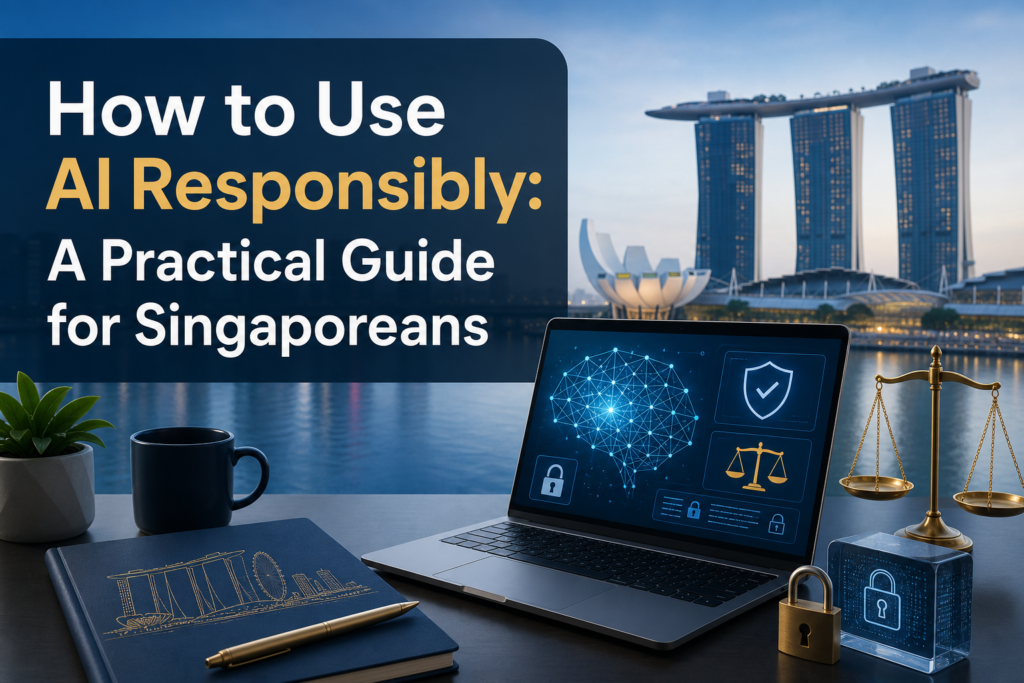
As AI tools become part of everyday professional and personal life in Singapore, the question of how to use them responsibly has become as important as how to use them effectively. Most of the discourse around AI focuses on what these tools can do – and they can do a lot. Less attention goes to what they should not do, what data they should not be given, and what responsibilities users carry when they use AI-generated content professionally or publicly.
This guide is a practical framework for responsible AI use in the Singapore context – covering data privacy, accuracy verification, professional disclosure, academic integrity, and the Singapore regulatory landscape.
Data Privacy: What Must Never Go Into AI Tools

The most common and serious way Singaporeans misuse AI tools is by entering data that should be protected. When you type information into ChatGPT, Claude, Gemini, or any other AI tool, that information is sent to the company’s servers. Depending on your account settings and the specific tool’s policies, it may be used to train future AI models.
Singapore’s Personal Data Protection Act (PDPA) creates obligations for how personal data must be handled. Entering another person’s personal data – their NRIC number, their salary information, their medical history, their home address – into an AI tool without their knowledge or consent is a potential PDPA violation.
The rule is simple: never enter the following into any AI tool unless you have specific contractual commitments about how that data is handled. NRIC numbers, passport numbers, or other national identification details. Financial account information – bank account numbers, credit card details. Medical information about any individual. Personal information about someone else that they have not consented to share. Confidential client information covered by any NDA or confidentiality agreement. Sensitive business information whose disclosure could harm your company or clients.
For professionals in regulated industries – financial advisors, lawyers, healthcare workers, accountants – the confidentiality obligations of your profession apply to information you enter into AI tools. Using a client’s financial details to prompt ChatGPT for advice, even privately, may violate your professional confidentiality obligations.
Accuracy and Verification: AI Can Be Wrong

AI tools produce confident-sounding outputs that can be completely incorrect. This phenomenon – called hallucination in AI research – occurs when an AI system generates plausible-sounding but factually false information. ChatGPT, Claude, and Gemini all hallucinate occasionally. Perplexity, because it searches live sources, hallucinate less but is not immune.
The responsible rule for using AI-generated information professionally: verify anything factual before using it. Check statistics against the original source. Verify regulatory information on the relevant government website. Confirm specific claims with current authoritative sources before including them in any professional deliverable.
For Singapore-specific information – MAS regulations, HDB rules, CPF rates, IRAS requirements – always verify on the official government website before using AI-generated information for any purpose that matters. The consequences of relying on incorrect regulatory information can be significant.
Professional Disclosure: When to Disclose AI Use
The question of when to tell others that AI helped create something you are presenting professionally is becoming more important as AI use becomes more widespread. There is no universal rule, but there are some useful principles.
Disclose when the other party has a right to know. If you are submitting work that is being evaluated partly on the quality of your own writing or thinking – academic work, job application materials, creative work submitted for assessment – using AI without disclosure is deceptive. Most Singapore educational institutions now have specific policies on this.
Disclose in client relationships where it is material. If you are charging a client for your expertise and creative judgment, and a significant portion of the deliverable was AI-generated without your substantive input, that raises questions about value delivered. The ethical standard is that AI assistance should enhance your professional contribution, not substitute for it.
At work, check your employer’s policy. Many Singapore companies are developing AI usage policies. Using AI tools for work-related tasks without knowing your employer’s position on this creates compliance risk.
Singapore’s Regulatory Context for AI
Singapore’s approach to AI regulation, as established by IMDA and MAS, is principles-based rather than prescriptive. The Model AI Governance Framework published by IMDA provides guidance for Singapore organisations on responsible AI adoption. Key principles include explainability (AI decisions affecting individuals should be explainable), fairness (AI should not perpetuate bias), accountability (humans remain responsible for AI outcomes), and transparency (organisations should be open about AI use).
For Singapore businesses using AI in customer-facing applications – chatbots, recommendation systems, automated decisions about customers – these principles translate into practical obligations. Be able to explain how the AI works. Test it for bias. Maintain human oversight. Tell customers when AI is involved.
Building Good AI Habits From the Start
The most important habit is using AI as a tool that enhances your capabilities rather than replacing your judgment. Read AI-generated content before using it. Verify factual claims. Add your own perspective and knowledge. Take responsibility for the final product. These habits protect you professionally and ensure that your AI use makes you genuinely more capable rather than more dependent.
Want to save time and money with AI starting today? Download the free Singapore AI Cheat Sheet, 10 prompts made for Singaporeans, plus a free 7-day email course delivered straight to your inbox. Grab it now at agentsetupsg.com/free instead.
Related resources
- Related guide: AI for Singapore Healthcare Workers: Practical Applications in 2026
- Practical walkthrough: What is Grok AI and Should Singaporeans Use It in 2026?
- Detailed breakdown: What is Microsoft Copilot and Should Singaporeans Use It in 2026?
- Product resource: 100 Prompts for SG Content Creators
- Product resource: 100 Prompts for SG Working Adults