
What Is an AI Agent? Why Every Singapore Business Needs to Know in 2026
If you have been following AI news, you have probably heard the term “AI agent” more and more. It sounds technical. But the concept is actually simple – and it represents a significant shift in what AI can do for your business.
This guide explains what AI agents are, how they are different from chatbots like ChatGPT, and what they can actually do for Singapore businesses today.
—

The Difference Between AI Chatbots and AI Agents
A chatbot (like ChatGPT or a customer service bot) waits for you to ask it something, gives you an answer, and stops there. It responds to one instruction at a time.
An AI agent takes a goal, breaks it into steps, takes actions to achieve those steps, and keeps going until the goal is done – often without you needing to be involved at every step.
Think of it this way:
| | Chatbot | AI Agent |
|–|——–|———|
| How it works | You ask, it answers | You give a goal, it takes steps to achieve it |
| Number of steps | One at a time | Multiple steps in sequence |
| Can it use other tools? | Usually no | Yes – can browse web, send emails, update spreadsheets |
| Does it need constant input? | Yes | No – it works autonomously |
| Example | “Write me a caption for this photo” | “Find 10 leads from LinkedIn, write personalised outreach emails for each, and add them to my CRM” |
—
A Simple Example: A Blog Post Agent
Here is a concrete example of what an AI agent does versus a chatbot.
Chatbot approach:
- You ask: “Write a blog post about AI for Singapore SMEs”
- It writes a blog post
- You copy it, format it, add images, post it manually
AI Agent approach:
- You say: “Research the top AI tools for Singapore SMEs, write a 1,000-word blog post, add SEO metadata, post it to my WordPress site, and share it on my LinkedIn”
- The agent researches the topic (using web search)
- It writes the post
- It formats it with headings and SEO fields
- It posts it directly to WordPress via API
- It shares the post on LinkedIn
You gave one instruction. It completed six steps. You did not touch it.
This is the shift happening right now.
—
How AI Agents Work (Without the Jargon)
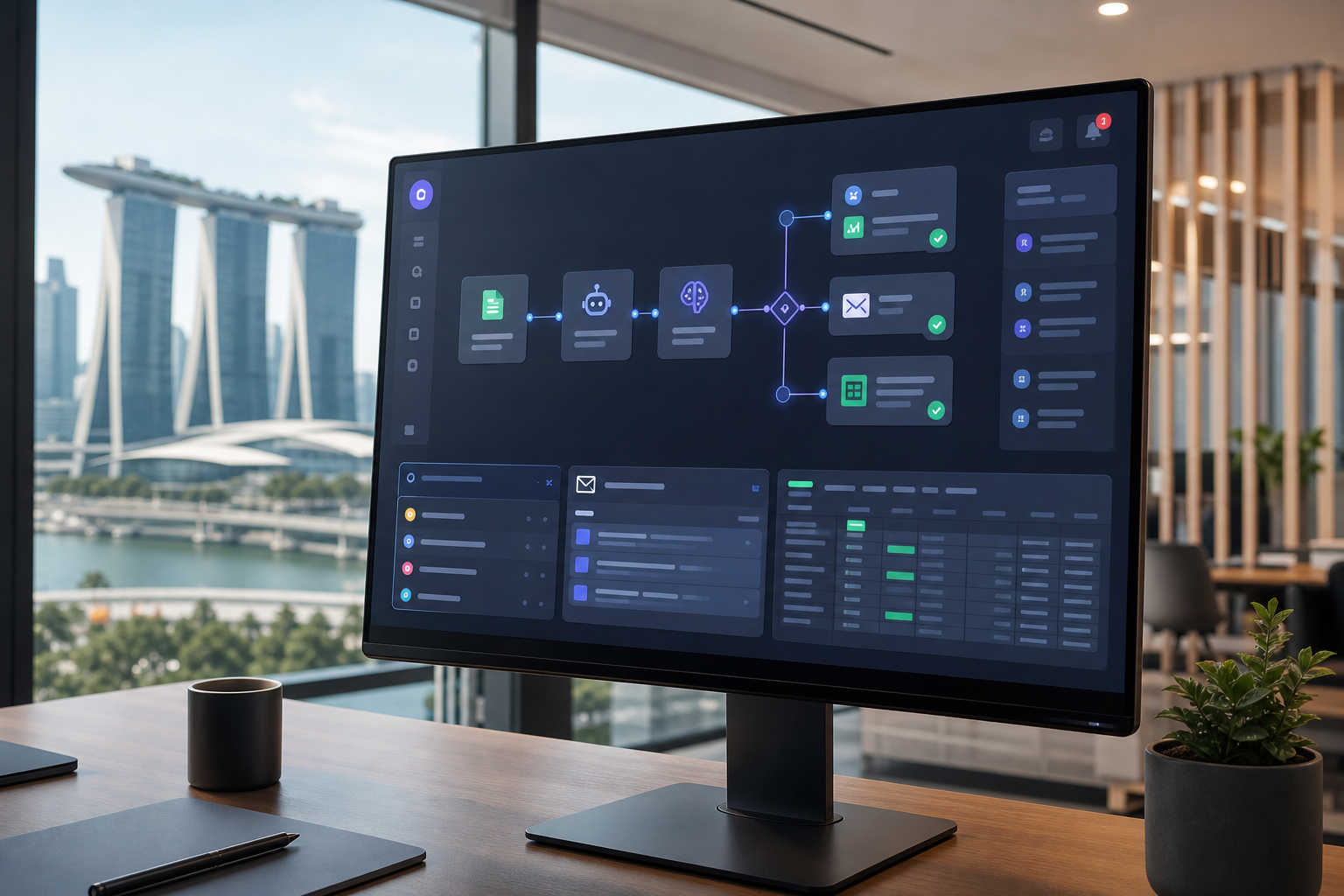
An AI agent has three key components:
1. A brain (the AI model)
This is usually a powerful language model like Claude, GPT-4, or Gemini. It understands instructions, makes decisions, and generates content.
2. Tools (what it can do)
Agents are connected to tools that let them take action in the world. Common tools include:
- Web search
- Email sending
- Calendar management
- CRM updates
- Document creation
- Social media posting
- Database queries
3. Memory (what it remembers)
Simple agents have short-term memory (they remember what happened in the current task). More advanced agents have long-term memory (they learn your preferences and improve over time).
When you run an agent, it uses the AI brain to decide what tool to use at each step, uses the tool, looks at the result, and decides what to do next – until the goal is reached.
—
What Singapore Businesses Are Using Agents For Right Now
Customer Support Agents
Instead of a simple FAQ chatbot, an agent can: look up the customer’s order history, check current stock levels, process a refund request, send a confirmation email, and update the CRM record – all from one customer message.
Lead Generation Agents
An agent can be given a company name, find the relevant decision-maker on LinkedIn, research the company’s recent news, write a personalised outreach email, and add the contact to a CRM – without human involvement at each step.
Content Production Agents
Set an agent running once a week: it researches trending topics, selects one, writes a blog post with SEO optimisation, creates a summary for LinkedIn, and posts both. One instruction, multiple published assets.
Data Processing Agents
An agent connected to your sales data can generate a weekly performance report, flag anomalies, write a plain-English summary, and email it to your team every Monday morning.
Recruitment Agents
For small businesses hiring: an agent can screen incoming CVs against a job description, score and rank candidates, send acknowledgement emails to applicants, and prepare a shortlist for the hiring manager.
—
AI Agents Available to Singapore Businesses Today
You do not need an enterprise software budget to use AI agents. Here are accessible options:
Make.com with AI steps
Make.com lets you build multi-step automations that include AI actions. Not a full agent, but it handles most practical use cases for SMEs. From USD $9/month.
n8n
Open-source automation platform that supports complex AI agent workflows. Free to self-host or around USD $20/month on their cloud plan. Steeper learning curve but very powerful.
Zapier with AI
Now includes AI steps that let you build simple agent-like workflows connecting hundreds of apps. Accessible for non-technical users.
Relevance AI
Designed specifically for building AI agents without coding. Popular with marketing and sales teams. Has a free tier to explore.
AgentGPT / Auto-GPT style tools
Open-source and experimental. Good for learning how agents work. Not recommended for production business use yet.
Claude Projects (Anthropic)
Claude’s Projects feature allows you to give Claude ongoing context, documents, and instructions so it behaves more like an agent for your specific business over time.
—
The Honest Limitations Right Now
AI agents are powerful but not perfect. Things to know:
They can make mistakes. An agent that sends emails autonomously can send the wrong thing to the wrong person. Always test in a controlled environment before giving an agent access to live systems.
They need clear instructions. Vague goals produce poor results. The better you define what success looks like, the better the agent performs.
They are not magic. An AI agent automates work – it does not create strategy, build relationships, or make judgment calls the way a human can.
Cost can scale up. Agents that run API calls repeatedly can accumulate costs. Monitor usage especially in the early stages.
—
Where to Start
If you are new to AI agents, the best first step is to get comfortable with AI automation before jumping to full agents.
Start with Make.com or Zapier to build a few simple automated workflows. Once you understand how automation works, adding AI steps and building towards agent behaviour is a natural next step.
The learning curve is worth it. Businesses that have working AI agents running today are compounding productivity advantages that will be very hard for late adopters to close.
—
AgentSetupSG is built specifically for Singapore businesses and professionals who want step-by-step guidance on setting up AI agents and automations – no engineering background required.