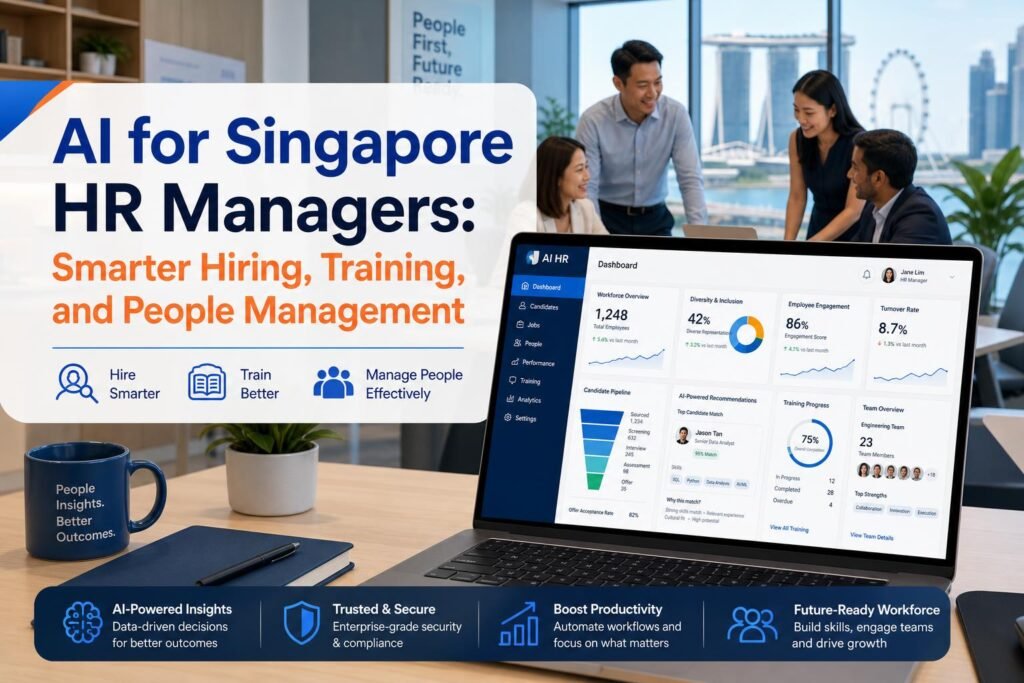
Singapore’s HR landscape in 2026 faces a combination of challenges that are testing the limits of what traditional HR practices can handle. A tight labour market with some of the lowest unemployment rates in Singapore’s history. Rising salary expectations across most sectors. An accelerating skills gap as technology changes faster than training programmes can adapt. Evolving MOM regulations on fair employment, mental health support, and AI disclosure in hiring. And all of this with HR teams that in most Singapore companies remain understaffed relative to the demands placed on them.
AI tools are not a solution to all of these challenges. But they are a meaningful tool for making HR professionals more effective – reducing the administrative burden so that HR managers can spend more time on the genuinely human aspects of their role that AI cannot do.

AI for Recruitment: Job Descriptions and Job Postings
Writing job descriptions is one of the most time-consuming and consequential activities in recruitment. A poorly written job description either attracts the wrong candidates or fails to attract the right ones. It may also inadvertently include language that violates the TAFEP Fair Employment guidelines, which specify that job descriptions should not contain discriminatory criteria related to race, religion, nationality, gender, age, disability, or family status.
ChatGPT can help Singapore HR managers write job descriptions that are compelling, accurate, and compliant. Use this prompt: Write a job description for a Singapore-based [job title] at a [describe company size and industry]. The key responsibilities are [list them]. The essential requirements are [list them]. The preferred qualifications are [list them]. The salary range is [range] SGD per month. Ensure the language complies with Singapore’s Fair Employment guidelines – avoid any discriminatory language or criteria. Make the job description feel engaging and like somewhere people would want to work, not just a list of requirements.
Review the output carefully – AI can still occasionally include subtly biased language despite instructions to the contrary. But the AI draft is a much better starting point than a blank page and typically requires only minor edits to be compliant and effective.
AI for Interview Preparation and Evaluation
Structured interviews – where every candidate is asked the same set of questions in the same order – consistently produce better hiring decisions than unstructured interviews. But designing structured interview questions for each role takes time that busy Singapore HR managers often do not have.
Use ChatGPT to generate structured interview question banks: Create 20 structured interview questions for a Singapore-based [job title] role. Include: 5 competency-based questions assessing [key competency 1] and [key competency 2], 5 situational questions that present realistic scenarios the person would face in this role, 5 technical knowledge questions appropriate for [seniority level], and 5 culture and values questions. For each question, include a brief description of what a strong answer would include.
The result is a ready-to-use interview guide that ensures consistency across all interviews for the same role, which both improves hiring quality and reduces the legal risk of inconsistent evaluation practices.

AI for Employee Training and Onboarding
Creating training materials is typically one of the most time-consuming HR tasks. Training manuals, onboarding programmes, e-learning scripts, facilitator guides – all are necessary for effective employee development but all are labour-intensive to produce.
Use ChatGPT to generate training content faster: Create a one-day onboarding programme for a new customer service executive joining a Singapore retail company. The programme should cover: company background and values, understanding our products and services, customer service standards and communication style, systems and tools training overview, and workplace policies and expectations. Include: timing for each session, activities and exercises, key messages for each section, and a simple assessment to check understanding at the end.
The AI output is a first draft that your HR team reviews, personalises with company-specific details, and refines. But it eliminates the blank-page problem and typically produces a usable 70 to 80% complete training plan that requires less time to finish than creating from scratch.
AI for Performance Review Documentation
Writing performance reviews for multiple employees is time-consuming and often emotionally demanding. AI can help HR managers and line managers write more consistent, fair, and constructive performance documentation.
Use this prompt for writing performance review narratives: Write a balanced performance review for an employee who: has demonstrated strong technical skills in [area], consistently meets deadlines, but needs to develop in [area of improvement] and has struggled with [specific challenge]. The overall rating is Meets Expectations. The tone should be professional, constructive, and focused on development. Include specific observable behaviours rather than vague generalisations. Avoid any language that could be interpreted as discriminatory. Suggest 2 to 3 specific development goals for the coming review period.
Always have the line manager who knows the employee well review and substantially personalise any AI-generated performance content. AI can help with structure, language, and balance, but the specific factual observations about individual performance must come from the people who have actually worked with the employee.
AI for HR Policy Development
HR policies – from AI usage policies to mental health leave policies to flexible work arrangement policies – are increasingly important for Singapore employers and increasingly time-consuming to develop and keep current as regulations and best practices evolve.
ChatGPT can draft HR policies for review by a qualified HR professional: Draft an AI tools usage policy for a Singapore SME with 25 employees. The policy should cover: which AI tools employees are permitted to use for work purposes, what types of company or client data must not be entered into AI tools, expectations around disclosure when AI is used in client-facing work, and consequences for misuse. The tone should be clear and practical rather than legalistic. The policy will be reviewed by our HR consultant before finalisation.
The critical caveat: HR policies in Singapore have legal implications and must be reviewed by a qualified HR professional or employment lawyer before implementation. AI drafts are starting points, not finished policies.
What AI Cannot Do in Singapore HR
AI cannot make hiring decisions. Algorithmic hiring – using AI to screen or rank candidates – has documented bias problems and raises significant TAFEP compliance concerns in Singapore. Use AI to assist HR professionals in preparing better questions and materials; do not use it to automate candidate selection.
AI cannot handle sensitive employee relations situations. Grievances, disciplinary matters, harassment complaints, mental health conversations – these require human empathy, professional judgment, and careful documentation that AI is not equipped to handle. AI can help you prepare documentation after the fact, but the human interaction must be genuinely human.
AI cannot replace the strategic HR function. Workforce planning, culture building, leadership development, and organisational change management require human strategic thinking and relationship-building that AI assists but does not replace.
Related reading on Agent Setup SG
- AI Tools for Singapore Students: Study Smarter and Get Ahead in 2026
- How to Use AI for Your Singapore Hawker Business (Practical Guide)
- How to Use Perplexity AI Instead of Google: The Complete Singapore Guide
FAQ: AI for Singapore HR Managers: Smarter Hiring, Training, and People Management
Is this suitable for beginners in Singapore?
Yes. This guide is written for practical beginners and focuses on clear steps.
Do I need paid tools to start?
No. You can start with free options and upgrade only when results justify it.
How quickly can I implement this?
Most people can complete a first setup in under one hour, then improve it over time.
What should I track first?
Track one key outcome such as leads, response rate, time saved, or conversion.
What common mistake should I avoid?
Do not skip the basics. Clear setup and consistent usage matter more than fancy features.
Free resource for Singapore readers: Want to save time and money with AI starting today? Download the free Singapore AI Cheat Sheet, 10 prompts made for Singaporeans, plus a free 7-day email course delivered straight to your inbox. Grab it now at agentsetupsg.com/free instead.
Related resources
- Related guide: How to Use AI for Singapore Logistics and Supply Chain Management
- Practical walkthrough: AI Tools for Singapore Freelancers: Work Smarter and Earn More in 2026
- Detailed breakdown: How Singaporeans Are Using AI to Invest Smarter in 2026
- Product resource: 100 Prompts for SG Content Creators
- Product resource: 100 Prompts for SG Working Adults