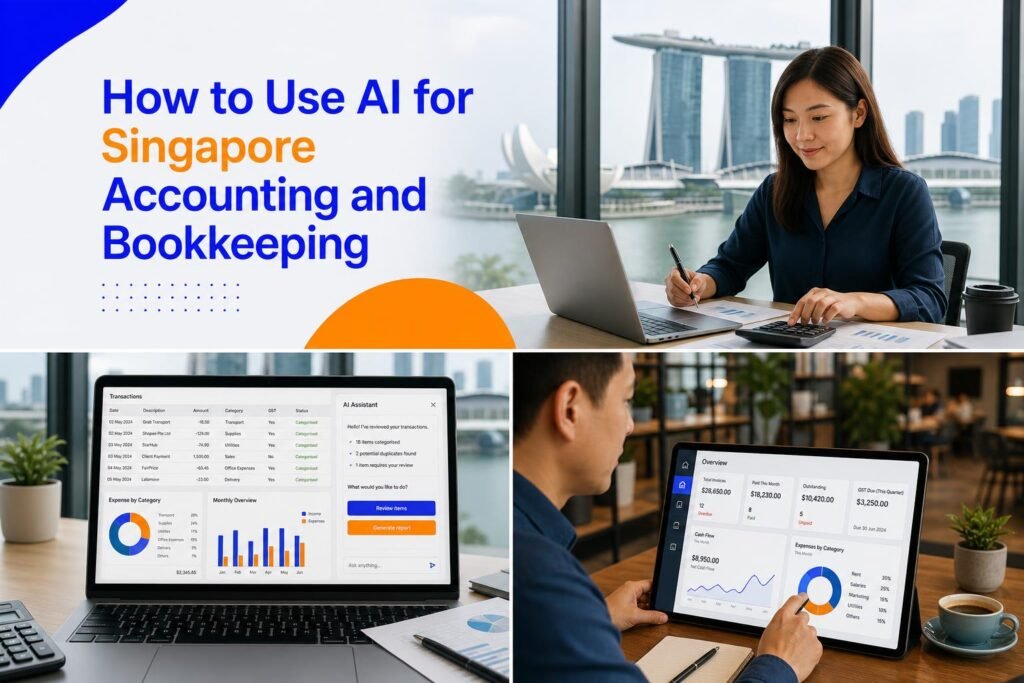
Managing finances is one of the most universally challenging aspects of running a Singapore business. Between GST registration and quarterly filing, corporate income tax, withholding tax, CPF contributions, XBRL reporting for companies, and the constant need to maintain accurate financial records, the accounting burden on Singapore SMEs is substantial. And for business owners without an accounting background, much of it is genuinely confusing.
AI tools can help in meaningful ways – as financial educators that explain complex concepts in plain English, as productivity tools that speed up routine financial tasks, and as smart assistants that help you prepare better for interactions with your accountant. What they cannot do is replace a qualified Singapore accountant for regulated compliance work. This guide is honest about both the potential and the limits.
Using AI to Understand Singapore Tax and Financial Concepts
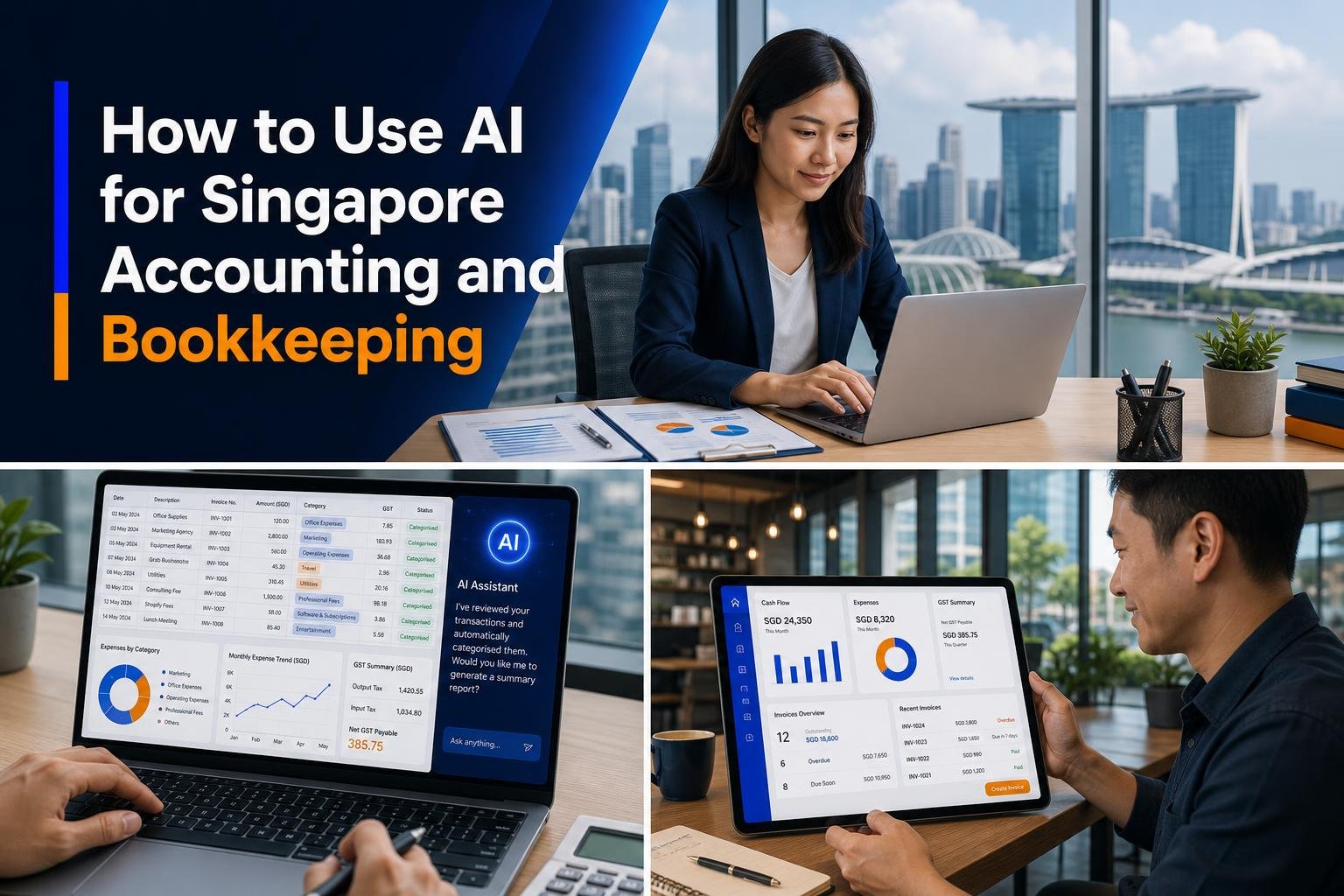
One of the most practical uses of AI for Singapore business owners is as a financial educator – a patient tutor available at any time to explain accounting concepts and Singapore-specific regulations in plain English.
For understanding GST: Ask ChatGPT to explain the GST registration threshold in Singapore and what it means for your business. What happens when my annual turnover exceeds $1 million? Do I need to register for GST and what does that require? What are the differences between standard-rated, zero-rated, and exempt supplies in Singapore GST? Having these concepts explained in conversational language before meeting your accountant means you can ask better questions and make more informed decisions.
For understanding corporate income tax: What is the three-line tax system for Singapore companies and when does it apply? What are the current tax exemptions for Singapore startups in their first three years? What business expenses are deductible against corporate income tax in Singapore? Can you explain the partial tax exemption scheme for Singapore companies?
For understanding CPF obligations: What are the current CPF contribution rates for Singapore citizens and PRs at different age brackets? When must CPF contributions be submitted and what are the penalties for late payment? What is Ordinary Wage and what counts as Additional Wage for CPF purposes?
Use Perplexity AI rather than ChatGPT for regulatory questions where currency matters. Singapore tax rules and CPF rates change periodically and Perplexity’s live web search means it will pull from current IRAS and CPF Board websites rather than potentially outdated training data.
AI-Powered Accounting Software Available in Singapore
Several accounting software platforms commonly used in Singapore have integrated AI features that automate routine bookkeeping tasks. These are not generic AI tools – they are accounting-specific AI that understands double-entry bookkeeping, VAT/GST, and financial reporting requirements.
Xero: One of the most widely used cloud accounting platforms in Singapore, Xero uses AI to automatically categorise bank transactions by comparing them to your historical categorisation patterns and to industry norms. It also uses AI for bank reconciliation matching, automatically suggesting which transactions match which bank entries. For Singapore businesses connected to a Singapore bank account, this automation can handle 70 to 80% of routine transaction categorisation automatically.
QuickBooks: Available in Singapore and uses similar AI capabilities for transaction categorisation, receipt capture and data extraction, and cash flow forecasting. The mobile app’s receipt capture feature – where you photograph a receipt and AI extracts the vendor, date, amount, and suggested category – is particularly practical for Singapore business owners who collect receipts throughout the day.
FreshBooks: Better suited to sole proprietors, freelancers, and very small Singapore businesses. Simpler interface than Xero or QuickBooks with AI features for automated invoice follow-up, expense categorisation from uploaded receipts, and basic financial reporting.
Using ChatGPT for Financial Analysis and Spreadsheet Work
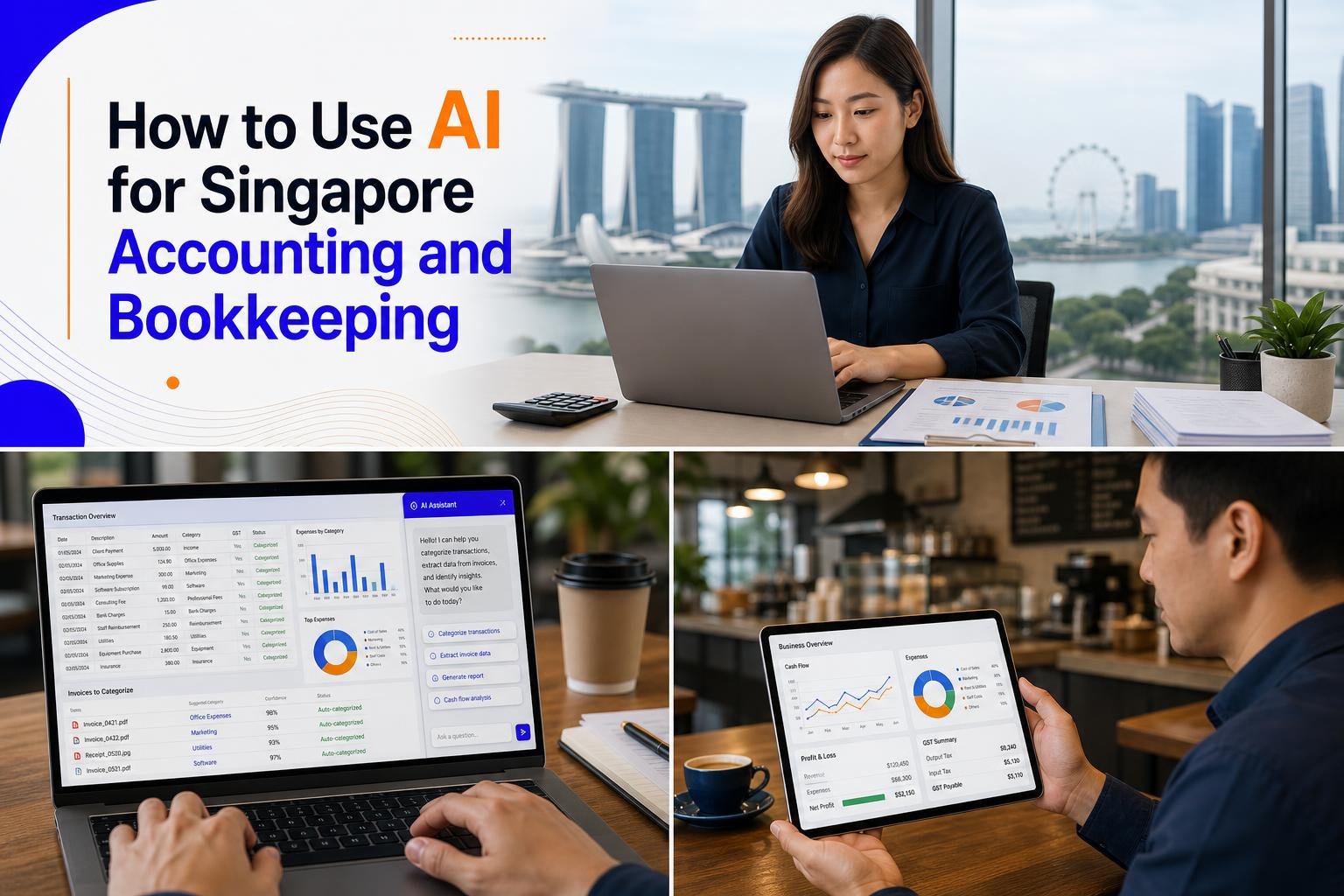
Many Singapore SMEs manage their finances in Excel or Google Sheets alongside or instead of dedicated accounting software. ChatGPT can significantly extend what you can do with these tools without needing to be a spreadsheet expert.
For formula creation: Write an Excel formula that calculates the GST amount (9%) from a price-inclusive-of-GST figure in column A and puts the GST amount in column B and the GST-exclusive price in column C. ChatGPT gives you the exact formula to copy and paste. Write a formula in Google Sheets that calculates the weighted average selling price across products in column A (products), column B (units sold), and column C (selling price per unit).
For financial template creation: Create a simple monthly profit and loss template for a Singapore café with the following revenue categories: dine-in, takeaway, GrabFood delivery, and catering. Expense categories should include: ingredient costs, staff salaries (with CPF noted separately), rent, utilities, marketing, and other overheads. Include a calculation for gross profit margin and net profit margin at the bottom.
For understanding your own financial reports: Paste your management accounts or financial summary into ChatGPT and ask it to explain what the numbers mean. I have my café’s P&L for last quarter. Revenue was $145,000, food cost was $43,500, labour was $52,000, rent was $18,000, and other costs were $12,000. Can you analyse this and tell me which ratios are concerning and what typical benchmarks are for a Singapore café? Is there anything I should discuss with my accountant?
Using AI to Prepare Better for Your Accountant
One of the highest-leverage uses of AI for Singapore business owners is preparation for meetings with their accountant. The more clearly you understand your financial situation and the more organised your records are, the more productive and less expensive these professional engagements are.
Before a tax planning meeting: Ask Perplexity to give you a current overview of Singapore’s corporate tax incentives and reliefs that might be relevant to your business type and size. Then ask ChatGPT to help you formulate the three to five most important questions to ask your accountant about minimising your company’s tax burden legally.
Before a GST review: Organise your GST-related transactions systematically, use ChatGPT to understand the GST treatment of any transactions you are unsure about, and arrive at the accountant’s office with specific questions about edge cases rather than needing the accountant to educate you on basic concepts.
Critical Limitations: What AI Cannot Do for Singapore Accounting
AI cannot file your IRAS returns or CPF submissions. These are regulated activities that require human responsibility and authorisation. AI cannot replace a qualified Singapore accountant for financial statement preparation required for bank lending, IRAS compliance, or annual return filing. AI can be wrong about specific tax rules, particularly for unusual or complex situations – always verify important regulatory information with your accountant or directly with IRAS. AI does not know your complete financial situation and therefore cannot give personalised tax advice.
Use AI to become a more financially literate business owner who makes better use of your accountant’s expertise. Do not use it as a replacement for that expertise.
Related reading on Agent Setup SG
- AI Tools for Singapore Students: Study Smarter and Get Ahead in 2026
- How to Use AI for Your Singapore Hawker Business (Practical Guide)
- How to Use Perplexity AI Instead of Google: The Complete Singapore Guide
FAQ: How to Use AI for Singapore Accounting and Bookkeeping
Is this suitable for beginners in Singapore?
Yes. This guide is practical and beginner-friendly.
Do I need paid tools to start?
No. Start with free options and scale later.
How quickly can I implement this?
Most people can complete a first setup in under one hour.
What should I track first?
Track one key outcome such as leads, time saved, or conversion improvements.
What mistake should I avoid?
Do not skip setup basics and validation steps.
Free resource for Singapore readers: Want to save time and money with AI starting today? Download the free Singapore AI Cheat Sheet, 10 prompts made for Singaporeans, plus a free 7-day email course delivered straight to your inbox. Grab it now at agentsetupsg.com/free instead.
Related resources
- Product resource: 100 Prompts for SG Content Creators
- Product resource: 100 Prompts for SG Working Adults
Reference: IRAS (Inland Revenue Authority of Singapore)