
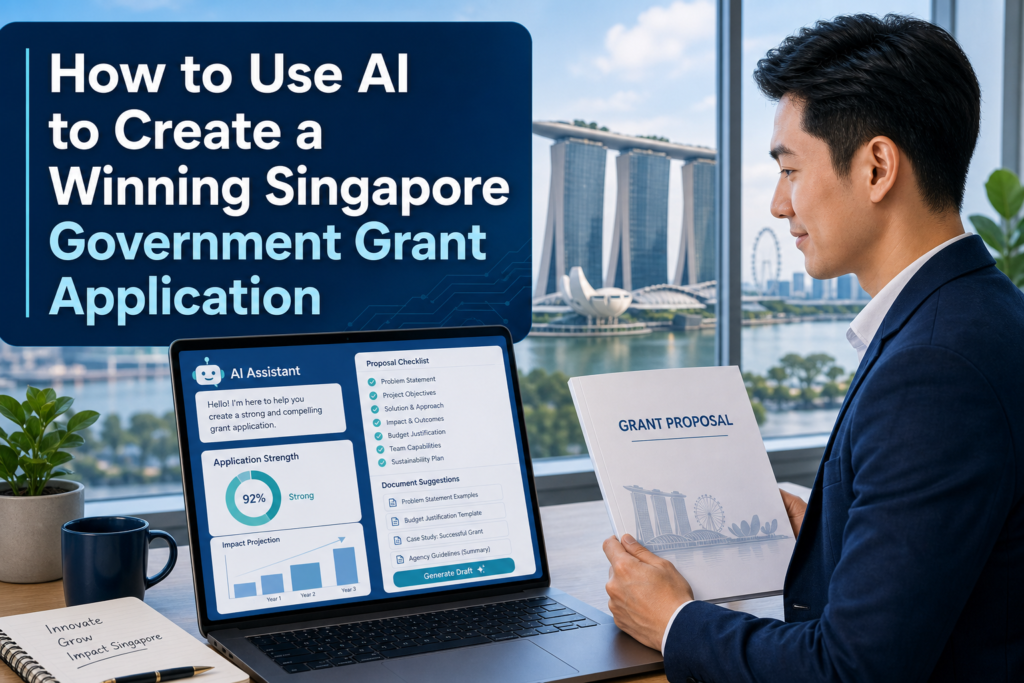
Singapore has some of the most accessible and generous business grant programmes in the world. Enterprise Singapore, IMDA, the Economic Development Board, and other government agencies collectively offer hundreds of millions of dollars in grant support annually to Singapore businesses for digitalisation, market expansion, capability development, and productivity improvement.
The challenge is that grant applications require clear, structured writing that directly addresses the evaluation criteria – and many business owners who have strong businesses write grant applications that fail to communicate their case effectively. AI tools can significantly improve the quality and persuasiveness of your grant writing.
Research the Grant Before Writing Anything

Before using AI to help write your application, you need to understand the specific grant you are applying for thoroughly. Use Perplexity AI for this research: What are the current eligibility criteria and evaluation criteria for the Enterprise Singapore Productivity Solutions Grant (PSG)? What does Enterprise Singapore’s Market Readiness Assistance (MRA) grant fund and what are the eligibility requirements for Singapore companies? What projects does the Enterprise Development Grant (EDG) support and how is it evaluated?
Then go directly to the official grant pages on the GoBusiness portal and read them carefully. AI research gives you a useful overview but official grant documentation must be your primary reference for eligibility and requirements.
Understanding What Grant Evaluators Look For

Before writing, use ChatGPT to help you understand the evaluator’s perspective: I am applying for [grant name] from Enterprise Singapore. Based on the grant objectives of [describe grant objectives], what are the key things a grant evaluator will be looking for in a strong application? What are the most common reasons Singapore SME grant applications are rejected? What language and framing best demonstrates alignment with Singapore’s economic development goals?
This preparation prompt helps you approach the writing from the evaluator’s perspective rather than your own, which is one of the most important shifts in grant writing effectiveness.
Writing Each Section of Your Grant Application
Problem statement and need: Write a compelling problem statement for a Singapore [type of business] grant application. The problem we are addressing is [describe your business challenge clearly and specifically]. This affects our business by [describe the impact in concrete terms – time lost, revenue impact, competitive disadvantage]. Industry data shows [include any relevant statistics about this challenge in your industry]. Write this to be clear, specific, and evidence-based rather than vague or generic.
Proposed solution and activities: Write a project description for a Singapore SME grant application. The project involves [describe what you plan to do]. The specific activities are [list them]. The expected outcomes are [describe what will change as a result]. This aligns with [grant name]’s objective of [describe the grant objective] because [explain the connection specifically]. Keep the language concrete and avoid buzzwords.
KPIs and measurable outcomes: Help me write 4 to 5 specific, measurable KPIs for a Singapore [type of business] grant application. The project will help us [describe your project goal]. The KPIs should be: realistic but meaningful, measurable within the project timeline, directly linked to the project activities, and demonstrate clear benefit to the business and potentially to the Singapore economy.
Common Grant Application Mistakes AI Can Help Avoid
Vagueness: The most common grant application failure is being vague about what you will do, why you will do it, and what will change as a result. AI helps you be specific – ask it to flag any vague language: Review this grant application section and identify any statements that are vague, unsubstantiated, or that a grant evaluator might question. For each, suggest how to make it more specific and evidence-based.
Missing alignment with grant objectives: Use ChatGPT to check alignment: Does this project description clearly demonstrate how our project meets the specific objectives of [grant name]? What additional language or framing would strengthen the alignment? Are there aspects of our project that we have not highlighted that would resonate with grant evaluators?
Weak financial justification: Many Singapore SME owners struggle to write the cost justification section. Help me write a compelling cost justification section for a grant application. We are requesting $[amount] SGD in grant funding. The specific costs are [break down the costs]. The ROI we expect from this investment is [describe expected returns]. This is a sound use of grant funds because [explain why this represents good value and genuine business need].
Final Review Before Submission
Before submitting, use AI for a final quality check: Review this complete grant application as an Enterprise Singapore grant evaluator would. Score it on: clarity of problem statement (1-10), strength of proposed solution (1-10), credibility of KPIs and expected outcomes (1-10), alignment with grant objectives (1-10), and overall persuasiveness (1-10). For any score below 8, explain specifically what would make it stronger. [paste your application]
Also have someone outside your business read the application before submitting. Fresh eyes often catch assumptions and gaps that you, as someone close to the subject matter, have missed.
Free resource for Singapore readers: Want to save time and money with AI starting today? Download the free Singapore AI Cheat Sheet, 10 prompts made for Singaporeans, plus a free 7-day email course delivered straight to your inbox. Grab it now at agentsetupsg.com/free instead.
Related resources
- Related guide: How to Create Viral TikTok Content Using AI: Singapore Creator’s Guide
- Product resource: 100 Prompts for SG Content Creators
- Product resource: 100 Prompts for SG Working Adults
Reference: Enterprise Singapore